
Saudi Arabia
Risk Level: One - Do Not Fly
[ about risk levels ]
Oct 2026: Saudi airspace remains technically open, but Houthi missile and drone attacks have escalated, repeatedly targeting OERK/Riyadh and other locations across the country. OERK reopened on Oct 18 after more than a week of disruption. Attacks have also been reported near OEDF/Dammam and airports in southwest Saudi Arabia.
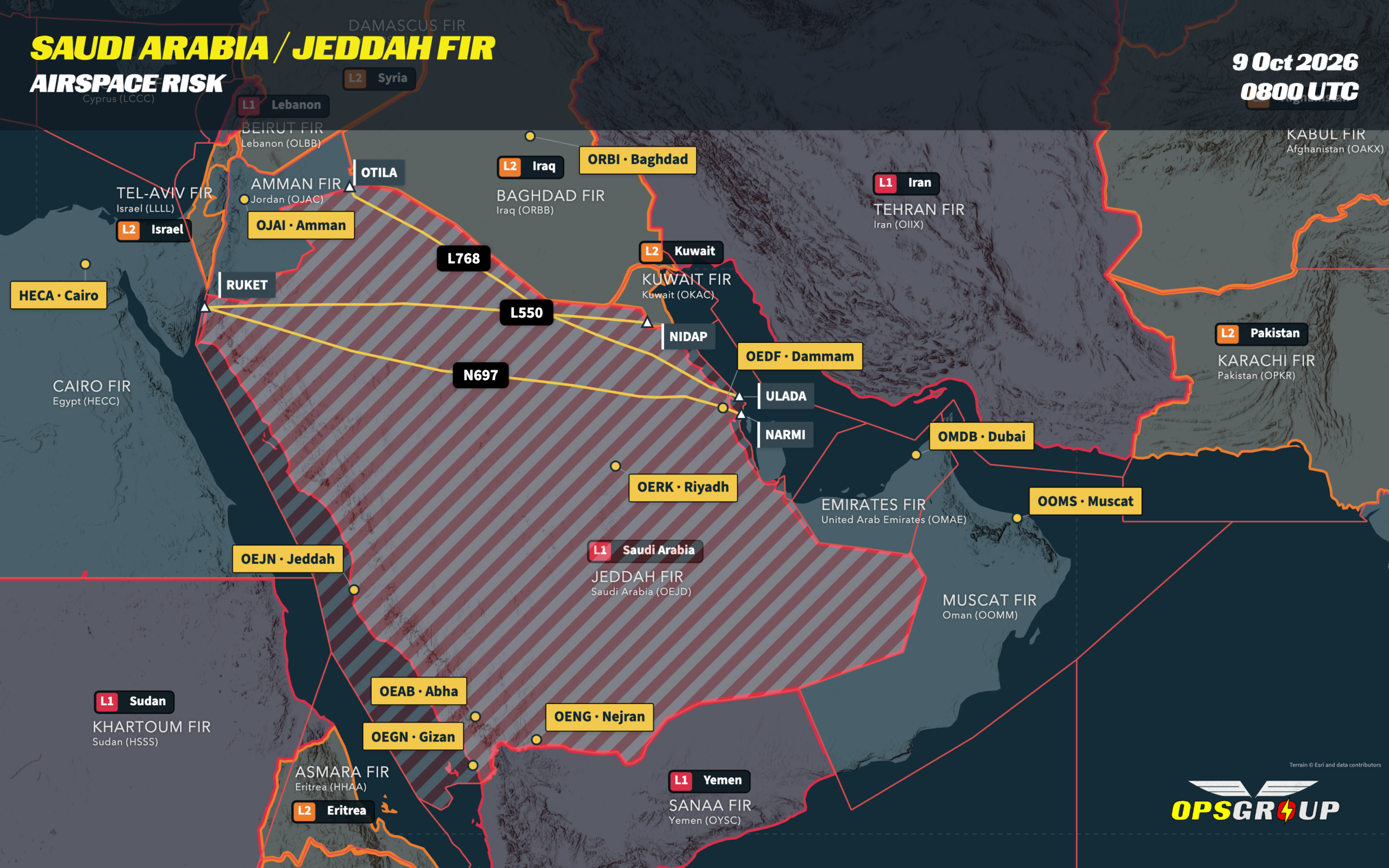
The primary risk is sustained missile and drone attacks by Houthi forces in Yemen, with recent strikes demonstrating that the threat extends across Saudi Arabia, including Riyadh. Air-defence responses also create a risk of misidentification and miscommunication - including along overflight routes.
Several states have issued airspace warnings for the OEJD/Jeddah FIR. We recommend avoiding Saudi airspace entirely, including overflights and the use of Saudi airports as en-route alternates. The northern route via Turkey, Azerbaijan and the Caspian Sea is the preferred alternative for Europe-Asia traffic.
Major events:
Oct 2026: Repeated Houthi attacks targeted OERK/Riyadh, including the passenger terminal. Attacks also reported near OEDF/Dammam, plus OEAB/Abha, OEGN/Jazan and OENG/Najran in the south.
Oct 2026: Safe Airspace raised Saudi Arabia warning to Level 1 - Do Not Fly.
Sep 2026: A Houthi ballistic missile targeted Riyadh, with subsequent disruption at OERK. Jeddah also closed at short notice during an air-defence response.
July 2026: Yemeni government forces struck the runway at OYSN/Sanaa to prevent an Iranian aircraft from landing. Houthi forces subsequently warned airlines against overflying Saudi Arabia.
2020-2022: Repeated Houthi drone and missile attacks targeted airports in southwest Saudi Arabia.
The primary risk is sustained missile and drone attacks by Houthi forces in Yemen, with recent strikes demonstrating that the threat extends across Saudi Arabia, including Riyadh. Air-defence responses also create a risk of misidentification and miscommunication - including along overflight routes.
Several states have issued airspace warnings for the OEJD/Jeddah FIR. We recommend avoiding Saudi airspace entirely, including overflights and the use of Saudi airports as en-route alternates. The northern route via Turkey, Azerbaijan and the Caspian Sea is the preferred alternative for Europe-Asia traffic.
Major events:
Oct 2026: Repeated Houthi attacks targeted OERK/Riyadh, including the passenger terminal. Attacks also reported near OEDF/Dammam, plus OEAB/Abha, OEGN/Jazan and OENG/Najran in the south.
Oct 2026: Safe Airspace raised Saudi Arabia warning to Level 1 - Do Not Fly.
Sep 2026: A Houthi ballistic missile targeted Riyadh, with subsequent disruption at OERK. Jeddah also closed at short notice during an air-defence response.
July 2026: Yemeni government forces struck the runway at OYSN/Sanaa to prevent an Iranian aircraft from landing. Houthi forces subsequently warned airlines against overflying Saudi Arabia.
2020-2022: Repeated Houthi drone and missile attacks targeted airports in southwest Saudi Arabia.
Current warnings list :
| Source | Reference | Issued | Valid to | |
|---|---|---|---|---|
| France | Notam LFFF F2118/26 | 14 Oct 2026 | 28 Oct 2026 | |
| Germany | Notam EDWW B0804/26 | 13 Oct 2026 | 10 Nov 2026 | |
| USA | Notam KICZ A0056/26 | 11 Oct 2026 | 10 Dec 2026 | |
| EASA | CZIB 2026-09-R1 | 09 Oct 2026 | 16 Nov 2026 | |
| Canada | Notam CZVR F5624/26 | 08 Oct 2026 | 23 Oct 2026 | |
| Italy | Notam LIRR E2226/26 | 01 Sep 2026 | 29 Nov 2026 | |
| Saudi Arabia | SUP ESCAT Procedures | 11 May 2026 | Ongoing | |
| France | AIC 011/26 | 29 Sep 2023 | Ongoing | |
| Canada | AIC 17/26 | 10 Aug 2023 | Ongoing | |
| USA | FAA Information Note Saudi Arabia/Yemen | 17 Mar 2022 | Ongoing | |
| Saudi Arabia | Notam OEJD W0120/21 | 28 Jan 2021 | Ongoing |
Source: France
Reference: Notam LFFF F2118/26
Issued: 14-Oct-26, valid until: 28 Oct 2026
Plain English: French operators should not enter most of the OEJD/Jeddah FIR except on routes across northern Saudi Arabia or along the western side of the country at FL320 or above. OEJN/Jeddah airport may also be used as an alternate.
FRENCH AIR CARRIERS AND CAPTAINS OF AIRCRAFT IN CHARGE OF AIR SERVICES OPERATED BY CARRIERS HOLDING AN OPERATING LICENSE ISSUED BY FRANCE, WHETHER THEY ARE CONTRACTUAL CARRIERS AND/OR OPERATING CARRIERS, OR PERFORMING AIR SERVICES THROUGH A WET LEASE OR A CODESHARE AGREEMENT AS WELL AS FOR ANY FLIGHT MADE WITH AN AIRCRAFT REGISTERED IN FRANCE ARE REQUESTED NOT TO PENETRATE INTO THE AIRSPACE OF SAUDI ARABIA (FIR JEDDAH (OEJD)),
- EXCEPT FOR ROUTES LOCATED NORTH OF THE LINE MARKED BY THE WAYPOINTS DELNA-RABUG-GEXUP-DEKOB-KUMBO, ON WHICH A FLIGHT LEVEL ABOVE OR EQUAL TO FL320 IS RESQUESTED TO BE MAINTAINED AT ALL TIMES.
- EXCEPT FOR ROUTES LOCATED WEST OF ROUTES M999 AND L677 ON WHICH A FLIGHT LEVEL ABOVE OR EQUAL TO FL320 IS RESQUESTED TO BE MAINTAINED AT ALL TIMES.
- JEDDAH AIRPORT (OEJN) MAY BE USED AS AN ALTERNATE AIRPORT WHEN PLANNING FLIGHTS.
THIS NOTAM SUPERSEDES THE RESTRICTIONS CONCERNING SAUDI ARABIA AIRSPACE (FIR JEDDAH (OEJD)) ISSUED IN PARAGRAPH 3.13 SAUDI ARABIA OF THE AIC NR 11/26 CURRENTLY IN EFFECT.
- EXCEPT FOR ROUTES LOCATED NORTH OF THE LINE MARKED BY THE WAYPOINTS DELNA-RABUG-GEXUP-DEKOB-KUMBO, ON WHICH A FLIGHT LEVEL ABOVE OR EQUAL TO FL320 IS RESQUESTED TO BE MAINTAINED AT ALL TIMES.
- EXCEPT FOR ROUTES LOCATED WEST OF ROUTES M999 AND L677 ON WHICH A FLIGHT LEVEL ABOVE OR EQUAL TO FL320 IS RESQUESTED TO BE MAINTAINED AT ALL TIMES.
- JEDDAH AIRPORT (OEJN) MAY BE USED AS AN ALTERNATE AIRPORT WHEN PLANNING FLIGHTS.
THIS NOTAM SUPERSEDES THE RESTRICTIONS CONCERNING SAUDI ARABIA AIRSPACE (FIR JEDDAH (OEJD)) ISSUED IN PARAGRAPH 3.13 SAUDI ARABIA OF THE AIC NR 11/26 CURRENTLY IN EFFECT.
Source: Germany
Reference: Notam EDWW B0804/26
Issued: 13-Oct-26, valid until: 10 Nov 2026
Plain English: German operators should not enter the OEJD/Jeddah FIR south of 26°N.
B0804/26 NOTAMR B0790/26
Q) EDXX/QAFXX/IV/NBO/E /000/999/5123N01019E262
A) EDWW EDGG EDMM B) 2610130735 C) 2611102359
E) SECURITY - HAZARDOUS SITUATION IN SAUDI-ARABIA CIVIL GERMAN AIR OPERATORS ARE RECOMMENDED NOT TO ENTER FIR JEDDAH (OEJD) SOUTH OF PARALLEL 260000N. POTENTIAL RISK TO AVIATION FROM ANTI-AVIATION, GROUND TO GROUND BALLISTIC WEAPONRY, MEDIUM RANGE BALLISTIC MISSILE ASSAULTS, UNMANNED AERIAL VEHICLE ATTACKS AND OTHER MILITARY OPERATIONS. CIVIL GERMAN AIR OPERATORS ARE ADVISED TO TAKE POTENTIAL RISK INTO ACCOUNT IN THEIR RISK ASSESSMENT AND ROUTING DECISIONS WITHIN FIR JEDDAH (OEJD) NORTH OF PARALLEL 260000N. POTENTIAL RISK TO AVIATION FROM ANTI-AVIATION, GROUND TO GROUND BALLISTIC WEAPONRY, MEDIUM RANGE BALLISTIC MISSILE ASSAULTS UNMANNED AERIAL VEHICLE ATTACKS AND OTHER MILITARY OPERATIONS.
Q) EDXX/QAFXX/IV/NBO/E /000/999/5123N01019E262
A) EDWW EDGG EDMM B) 2610130735 C) 2611102359
E) SECURITY - HAZARDOUS SITUATION IN SAUDI-ARABIA CIVIL GERMAN AIR OPERATORS ARE RECOMMENDED NOT TO ENTER FIR JEDDAH (OEJD) SOUTH OF PARALLEL 260000N. POTENTIAL RISK TO AVIATION FROM ANTI-AVIATION, GROUND TO GROUND BALLISTIC WEAPONRY, MEDIUM RANGE BALLISTIC MISSILE ASSAULTS, UNMANNED AERIAL VEHICLE ATTACKS AND OTHER MILITARY OPERATIONS. CIVIL GERMAN AIR OPERATORS ARE ADVISED TO TAKE POTENTIAL RISK INTO ACCOUNT IN THEIR RISK ASSESSMENT AND ROUTING DECISIONS WITHIN FIR JEDDAH (OEJD) NORTH OF PARALLEL 260000N. POTENTIAL RISK TO AVIATION FROM ANTI-AVIATION, GROUND TO GROUND BALLISTIC WEAPONRY, MEDIUM RANGE BALLISTIC MISSILE ASSAULTS UNMANNED AERIAL VEHICLE ATTACKS AND OTHER MILITARY OPERATIONS.
Source: USA
Reference: Notam KICZ A0056/26
Issued: 11-Oct-26, valid until: 10 Dec 2026
Plain English: Caution for US operators in the OEJD/Jeddah FIR due to potential risks from ongoing military activity and GNSS interference.
SECURITY UNITED STATES OF AMERICA ADVISORY FOR POTENTIALLY HAZARDOUS SITUATION IN THE JEDDAH FLIGHT INFORMATION REGION (OEJD)
U.S. OPERATORS ARE ADVISED TO EXERCISE CAUTION WHEN OPERATING IN THE JEDDAH FLIGHT INFORMATION REGION (OEJD) DUE TO SAFETY-OF-FLIGHT RISKS ASSOCIATED WITH ONGOING MILITARY ACTIVITIES AND GNSS INTERFERENCE. THREATS COULD POSE A POTENTIAL RISK TO AIRCRAFT AT ALL ALTITUDES, INCLUDING DURING OVERFLIGHT, THE ARRIVAL, AND DEPARTURE PHASES OF FLIGHT.
THIS NOTAM APPLIES TO ALL U.S. AIR CARRIERS AND COMMERCIAL OPERATORS; ALL PERSONS EXERCISING THE PRIVILEGES OF AN AIRMAN CERTIFICATE ISSUED BY THE FAA, EXCEPT SUCH PERSONS OPERATING U.S.-REGISTERED AIRCRAFT FOR A FOREIGN AIR CARRIER; AND ALL OPERATORS OF CIVIL AIRCRAFT REGISTERED IN THE UNITED STATES, EXCEPT WHEN THE OPERATOR OF SUCH AIRCRAFT IS A FOREIGN AIR CARRIER.
REPORT ANY SAFETY/SECURITY INCIDENTS OBSERVED/EXPERIENCED WHILE OPERATING IN THE AFFECTED AIRSPACE TO THE FAA'S WASHINGTON OPERATIONS CENTER AT 1(202) 267-3333.
U.S. OPERATORS ARE ADVISED TO EXERCISE CAUTION WHEN OPERATING IN THE JEDDAH FLIGHT INFORMATION REGION (OEJD) DUE TO SAFETY-OF-FLIGHT RISKS ASSOCIATED WITH ONGOING MILITARY ACTIVITIES AND GNSS INTERFERENCE. THREATS COULD POSE A POTENTIAL RISK TO AIRCRAFT AT ALL ALTITUDES, INCLUDING DURING OVERFLIGHT, THE ARRIVAL, AND DEPARTURE PHASES OF FLIGHT.
THIS NOTAM APPLIES TO ALL U.S. AIR CARRIERS AND COMMERCIAL OPERATORS; ALL PERSONS EXERCISING THE PRIVILEGES OF AN AIRMAN CERTIFICATE ISSUED BY THE FAA, EXCEPT SUCH PERSONS OPERATING U.S.-REGISTERED AIRCRAFT FOR A FOREIGN AIR CARRIER; AND ALL OPERATORS OF CIVIL AIRCRAFT REGISTERED IN THE UNITED STATES, EXCEPT WHEN THE OPERATOR OF SUCH AIRCRAFT IS A FOREIGN AIR CARRIER.
REPORT ANY SAFETY/SECURITY INCIDENTS OBSERVED/EXPERIENCED WHILE OPERATING IN THE AFFECTED AIRSPACE TO THE FAA'S WASHINGTON OPERATIONS CENTER AT 1(202) 267-3333.
Source: EASA
Reference: CZIB 2026-09-R1
Issued: 09-Oct-26, valid until: 16 Nov 2026
Plain English: Operators should avoid two areas of Saudi airspace - one in the southeast (RIBOK-BOSUT-MIGDA-RAGNO-MIXUG-DEKLO-OBSAM-SILPA) and one in the northwest (ULBAM-TOTEB-DURMA-LAKSO-SOLAT). Caution is advised in the remainder of the Jeddah FIR.
This CZIB is issued based on information currently available to EASA, the European Commission and EU Member States in order to share information which is considered necessary to ensure the safety of flights over zones of interest and indicate areas of high risk.
As a consequence of the military conflict between the United States and Iran, the regional security situation remains highly volatile, with significant kinetic military activity affecting Saudi airspace.
In September 2026, the Houthis have significantly increased the frequency and geographic scope of attacks against Saudi maritime, energy and infrastructure targets, including in the Red Sea and in the Gulf of Aden. Besides oil and energy infrastructures, also military and aviation-related infrastructures across Saudi Arabia have been repeatedly targeted by missiles and drones.
While the southern and south-western parts of Saudi airspace remain particularly exposed due to their proximity to Houthi-controlled areas in Yemen, recent attacks have demonstrated the ability and intent of the Houthis to strike targets deeper inside Saudi territory, including in the Riyadh, Tabuk, Medina and Yanbu areas.
Within this broader escalation observed in late September and early October, repeated missile and drone attacks targeted the Riyadh area, including its airport. During this period, attacks also showed a greater focus on aviation infrastructure than previously, increasing risks to aircraft on the ground and during take-off and landing in the affected areas.
These recurrent missile and drone attacks, together with the activation of air-defence systems, create an increased risk of misidentification of civil aircraft, as well as risks associated with missile and drone overflights, interception activity and falling debris.
The expansion of kinetic activity in September 2026 across a wider part of the Kingdom also increases the potential exposure of civil aviation beyond the areas previously affected by Houthi attacks requiring operators to conduct close monitoring and contingency planning.
While Saudi Arabia has demonstrated an ability to manage its airspace effectively, including through tactical deconfliction and Emergency Security Control of Air Traffic (ESCAT) measures, the operating environment remains vulnerable to rapid deterioration due to external risks beyond the control of the national authorities.
EASA, together with the Commission and Member States, will continue to closely monitor the situation, with a view to assess whether there is an increase or decrease of the risk for EU aircraft operators due to the evolution of the threat and risk situation.
Air operators should:
1. Not operate, at all flight levels and altitudes, within the portions of the airspace of Saudi Arabia defined by the Jeddah FIR boundary and each of the lines connecting the following navigation points:
1. RIBOK – BOSUT - MIGDA - RAGNO – MIXUG - DEKLO - OBSAM – SILPA; and
2. ULBAM – TOTEB – DURMA – LAKSO - SOLAT.
2. Exercise caution and take potential risks into account when operating in the remainder of the FIR Jeddah.
3. Ensure that an up-to-date risk assessment and a high level of contingency planning are in place for operations within the affected airspace, and be prepared for short notice instructions from the State authorities.
4. Closely monitor airspace developments in the region and follow all available aeronautical publications concerning the region, including information shared through the European Information Sharing and Cooperation Platform on Conflict Zones, alongside available guidance or direction from their national authorities.
As a consequence of the military conflict between the United States and Iran, the regional security situation remains highly volatile, with significant kinetic military activity affecting Saudi airspace.
In September 2026, the Houthis have significantly increased the frequency and geographic scope of attacks against Saudi maritime, energy and infrastructure targets, including in the Red Sea and in the Gulf of Aden. Besides oil and energy infrastructures, also military and aviation-related infrastructures across Saudi Arabia have been repeatedly targeted by missiles and drones.
While the southern and south-western parts of Saudi airspace remain particularly exposed due to their proximity to Houthi-controlled areas in Yemen, recent attacks have demonstrated the ability and intent of the Houthis to strike targets deeper inside Saudi territory, including in the Riyadh, Tabuk, Medina and Yanbu areas.
Within this broader escalation observed in late September and early October, repeated missile and drone attacks targeted the Riyadh area, including its airport. During this period, attacks also showed a greater focus on aviation infrastructure than previously, increasing risks to aircraft on the ground and during take-off and landing in the affected areas.
These recurrent missile and drone attacks, together with the activation of air-defence systems, create an increased risk of misidentification of civil aircraft, as well as risks associated with missile and drone overflights, interception activity and falling debris.
The expansion of kinetic activity in September 2026 across a wider part of the Kingdom also increases the potential exposure of civil aviation beyond the areas previously affected by Houthi attacks requiring operators to conduct close monitoring and contingency planning.
While Saudi Arabia has demonstrated an ability to manage its airspace effectively, including through tactical deconfliction and Emergency Security Control of Air Traffic (ESCAT) measures, the operating environment remains vulnerable to rapid deterioration due to external risks beyond the control of the national authorities.
EASA, together with the Commission and Member States, will continue to closely monitor the situation, with a view to assess whether there is an increase or decrease of the risk for EU aircraft operators due to the evolution of the threat and risk situation.
Air operators should:
1. Not operate, at all flight levels and altitudes, within the portions of the airspace of Saudi Arabia defined by the Jeddah FIR boundary and each of the lines connecting the following navigation points:
1. RIBOK – BOSUT - MIGDA - RAGNO – MIXUG - DEKLO - OBSAM – SILPA; and
2. ULBAM – TOTEB – DURMA – LAKSO - SOLAT.
2. Exercise caution and take potential risks into account when operating in the remainder of the FIR Jeddah.
3. Ensure that an up-to-date risk assessment and a high level of contingency planning are in place for operations within the affected airspace, and be prepared for short notice instructions from the State authorities.
4. Closely monitor airspace developments in the region and follow all available aeronautical publications concerning the region, including information shared through the European Information Sharing and Cooperation Platform on Conflict Zones, alongside available guidance or direction from their national authorities.
Source: Canada
Reference: Notam CZVR F5624/26
Issued: 08-Oct-26, valid until: 23 Oct 2026
Plain English: Canadian operators are recommended not to enter the OEJD/Jeddah FIR at all levels due to ongoing risks associated with military activity, including drones, missiles and air defence activations. This supercedes the advice found within AIC 17/26.
F5624/26 NOTAMN
A) CZVR CZEG B) 2610081901 C) 2610232359
E) AIRSPACE SECURITY WARNING ISSUED BY THE DEPARTMENT OF TRANSPORT IN RESPONSE TO THE SECURITY SITUATION IN SAUDI ARABIA. CANADIAN AIR OPERATORS AND OWNERS OF AIRCRAFT REGISTERED IN CANADA ARE RECOMMENDED TO NOT ENTER THE JEDDAH FIR (OEJD) DUE TO POTENTIAL RISK TO AVIATION FROM ONGOING MILITARY ACTIVITY, INCLUDING MISSILES, DRONES, AND AIR DEFENCE OPERATIONS. THIS NOTAM SUPERSEDES THE ADVICE FOR SAUDI ARABIA IN AIC 17/26.)
A) CZVR CZEG B) 2610081901 C) 2610232359
E) AIRSPACE SECURITY WARNING ISSUED BY THE DEPARTMENT OF TRANSPORT IN RESPONSE TO THE SECURITY SITUATION IN SAUDI ARABIA. CANADIAN AIR OPERATORS AND OWNERS OF AIRCRAFT REGISTERED IN CANADA ARE RECOMMENDED TO NOT ENTER THE JEDDAH FIR (OEJD) DUE TO POTENTIAL RISK TO AVIATION FROM ONGOING MILITARY ACTIVITY, INCLUDING MISSILES, DRONES, AND AIR DEFENCE OPERATIONS. THIS NOTAM SUPERSEDES THE ADVICE FOR SAUDI ARABIA IN AIC 17/26.)
Source: Italy
Reference: Notam LIRR E2226/26
Issued: 01-Sep-26, valid until: 29 Nov 2026
Plain English: Caution to Italian operators in the OEJD/Jeddah FIR where ATC could apply ESCAT procedures with short notice.
ITALIAN AIR CARRIERS AND CAPTAINS OF AIRCRAFT IN CHARGE OF AIR SERVICES OPERATED BY CARRIERS HOLDING AN OPERATING LICENSE ISSUED BY ITALY, WHETHER THEY ARE CONTRACTUAL CARRIERS AND/OR OPERATING CARRIERS, OR PERFORMING AIR SERVICES THROUGH A WET LEASE OR A CODESHARE AGREEMENT AS WELL AS FOR ANY FLIGHT MADE WITH AN AIRCRAFT REGISTERED IN ITALY WHEN PLANNING FLIGHT OPERATIONS WITHIN JEDDAH FIR (OEJD) ARE RECOMMENDED TO EXERCISE ENHANCED CAUTION AND TO FOLLOW INSTRUCTIONS FROM SAUDI AUTHORITIES PROVIDING AIR TRAFFIC MANAGEMENT PAYING PARTICULAR ATTENTION TO RESTRICTIONS OR INTERDICTIONS PUBLISHED WITH VERY SHORT NOTICE AND TO EASA SAFETY DIRECTIVES.
Source: Saudi Arabia
Reference: SUP ESCAT Procedures
Issued: 11-May-26, valid until: Ongoing
Plain English: ESCAT (Emergency Security Control of Air Traffic) procedures are activated in southern Jeddah FIR due to the conflict in Yemen. This restricts available routes and flight levels, with specific routings for airports in the area. Pilots must maintain a listening watch on ATC frequencies and strictly follow ATC instructions.
Click link for SUP with full procedures.
Source: France
Reference: AIC 011/26
Issued: 29-Sep-23, valid until: Ongoing
Plain English: French operators should exercise caution in the southwest of the OEJD/Jeddah FIR where ATC could apply ESCAT procedures.
From 29/09/2023 and until further notice, pilots in command of aircraft performing air services mentioned in paragraph 1.1 are requested :
- to exercise great caution in the southwest of JEDDAH FIR (OEJD) where the airports of Abha (OEAB), Jazan (OEGN), Nejran (OENG), Sharurah (OESH), Wadi Al Dawasir (OEWD), Al Bahah (OEBA) and Bisha (OEBH) are located, in which ESCAT (Emergency Security Control of Air Traffic) may be activated by NOTAM from the Saudi authorities, and
- to monitor the appropriate ATC frequencies and to comply strictly with the instructions given by the Saudi authorities providing air traffic services.
- to exercise great caution in the southwest of JEDDAH FIR (OEJD) where the airports of Abha (OEAB), Jazan (OEGN), Nejran (OENG), Sharurah (OESH), Wadi Al Dawasir (OEWD), Al Bahah (OEBA) and Bisha (OEBH) are located, in which ESCAT (Emergency Security Control of Air Traffic) may be activated by NOTAM from the Saudi authorities, and
- to monitor the appropriate ATC frequencies and to comply strictly with the instructions given by the Saudi authorities providing air traffic services.
Source: Canada
Reference: AIC 17/26
Issued: 10-Aug-23, valid until: Ongoing
Plain English: Canadian operators advised caution in the OEJD/Jeddah FIR due to potential risk from anti-aviation weaponry and military operations; also due to short notice ESCAT rules in airspace next to Yemen.
Level 1 (Information)
SECURITY – HAZARDOUS SITUATION IN SAUDI ARABIA.
Canadian Air Operators and owners of aircraft registered in Canada are advised to take all potential risk information into account in their risk assessment routing decisions within FIR Jeddah (OEJD). Potential risk from anti-aviation weaponry and military operations. ESCAT (Emergency Security Control of Air Traffic) rules may be activated by NOTAM from the Saudi authorities in the southwest area of FIR OEJD.
SECURITY – HAZARDOUS SITUATION IN SAUDI ARABIA.
Canadian Air Operators and owners of aircraft registered in Canada are advised to take all potential risk information into account in their risk assessment routing decisions within FIR Jeddah (OEJD). Potential risk from anti-aviation weaponry and military operations. ESCAT (Emergency Security Control of Air Traffic) rules may be activated by NOTAM from the Saudi authorities in the southwest area of FIR OEJD.
Source: USA
Reference: FAA Information Note Saudi Arabia/Yemen
Issued: 17-Mar-22, valid until: Ongoing
Plain English: There is a potential risk to ops at Saudi airports and for overflights of the OEJD/Jeddah FIR due to Houthi drone and missile attacks from Yemen and the associated defensive operations.
Title: FAA Information Note - Saudi Arabia/Yemen: Houthi UAS Attack in Riyadh.
Click the link for full text.
Click the link for full text.
Source: Saudi Arabia
Reference: Notam OEJD W0120/21
Issued: 28-Jan-21, valid until: Ongoing
Plain English: ESCAT rules may be activated at any time in the south part of the OEJD/Jeddah FIR, when Saudi air defenses are repelling drone and missile attacks from Yemen. Operators will likely be given a change of route directly out of the airspace, or will be directed to land at the nearest airport.
DUE TO CONFLICT IN YEMEN BETWEEN LEGITIMATE GOVERNMENT AND THE HOUTHI MILITIA SUPPORTED BY IRANIAN REGIME ESCAT IS ACTIVATED IN THE SOUTH PART OF JEDDAH FIR FLYING RULES AND INFORMATION ON AVAILABLE ATS ROUTES ARE DESCRIBED IN AIP SUP 02/2021. PILOTS SHALL KEEP LISTENING TO THE APPROPRIATE ATC FREQUENCIES AND SHALL ADHERE STRICTLY TO ATC INSTRUCTIONS WHEN FLYING TO/FROM THE SOUTHERN AIRPORTS DUE TO DEFENSE RESPONSES THAT MAY OCCUR. IN ADDITION, SAUDI ARABIA IS PUTTING IN PLACE MEASURES TO MITIGATE RISK THAT MIGHT RESULT FROM LIMITED LONG-RANGE MISSILES AND UNMANNED AIRCRAFT SYSTEM CAPABILITIES THAT MAY TARGET AIRPORTS WITHIN JEDDAH FIR. OPERATORS MAY CONSIDER THIS INFORMATION WHEN CONDUCTING RISK ASSESSMENT.
28 JAN 14:00 2021 UNTIL PERM. CREATED: 28 JAN 14:01 2021
28 JAN 14:00 2021 UNTIL PERM. CREATED: 28 JAN 14:01 2021